Showing posts with label diving. Show all posts

Tuesday, 21 July 2009

Dive at Ćutin

I had a great dive at the Mali Ćutin island last weekend. The sea was crystal clear, so you could see the surface from 40 meters. The dive is wall-dive and the scenery is great. There was a great school of fishes, a lot of holes in the walls, deep purple gorgonias etc. The bottom is sandy and the upper flat part (around 7 meters) is covered in posidonia oceanica. The photos below took my dad (I was modeling at the time, I didn’t take my camera with me because of unrelated reasons).

cres_cutin

DSC_4332

cutin_objasnjenje

FRK_6910

FRK_6876

Sunday, 19 July 2009

Gacka Eco-Action 18.7.2009

Majerovo vrilo panorama Majerovo vrilo

Yesterday, our diving club KPA Adria from Kraljevica attended an “action” (in Croatia: where group of people do something for public for free) which consisted of cleaning the riverbed under some bridges near river Gacka’s bridges. So we were 9 divers and some other support staff (friends and family) which was divided in 4 teams. Another friend and fellow diver and me cleaned the riverbed below the bridge which you can see on the photo below. The link to the actual map is here.

mapa

General map of the location

Majerovo vrilo was our base point and a great place to dive by the way (huge cavern system, and the biggest of the three exit points of the Gacka river). The place is shown on the first photo. Each team was assigned couple of helpful local people to get the trash out of the water. Our dive lasted around and hour. The water was somewhat clear and not too fast, but the temperature was only 10.8 degrees centigrade. That wouldn’t be a problem if I brought my dry suit but I didn’t (its summer after all;) but still that wasn’t a problem to be honest. The most important thing on a wet suit is to seal properly. Around 5 or 6 large sacks later (around 1h) we were finished with our bridge. My dive buddy found an unexploded mortar shell among other trash which we reported to the authorities immediately. After the dive we meet up at Majerovo vrilo again and we had a great with the rest of the team. Overall, our team took out quite a chunk of discarded trash so I do look forward for the cleaning at the generally the same place in some future time.

Take a look at the photo gallery.

Wednesday, 3 June 2009

Caska, island of Pag, Croatia archeological excavation 2009

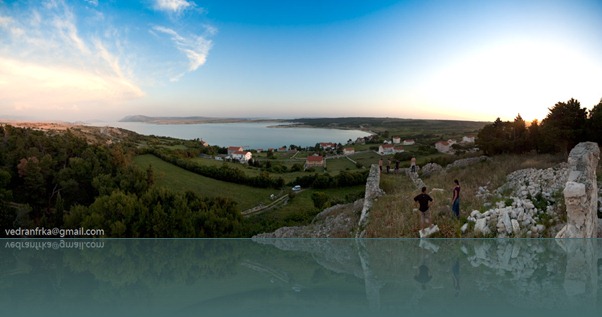
caska panorama 2

I know that I haven’t updated in a while so I’ll try to make up somewhat with this post.

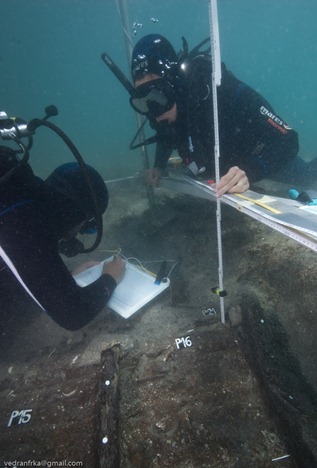
I’ve been to archeological underwater excavation/survey at the small town called Caska (latin: Cissa) which is located on the beautiful island of Pag in Croatia. I’ve been as a part of Croatian-lead, French, Italian and Macedonian team of archeologists who were excavating an ancient wooden ship which was found last year. My job there was to photograph both underwater and above water as my knowledge of archeology can be summed up in two words: below basic. Lets first talk about the place itself. Ancient Cissa was a large estate (many villas and probably ships) of some famous roman senator which name escapes me. I did read it, but of course I forgot it. The place now is very interesting. The whole bay is very shallow (few meters at most) and somewhat well protected from wind (except from the Jugo – south wind which can produce big waves). All along the beaches (which are very narrow, only a couple of meters) there are still preserved huge ancient walls, walls of the houses (the other 3 walls collapsed in the sea with time or because of some other reason: earthquake(?) or maybe some plundering), walls from the water reservoirs etc. The reason why the beaches are narrow is that because the soil comes almost to the sea line so the big waves erode it revealing the stone base.

Our ship was around 15m from the beach at the depth of around 1.8m. The good news is that the whole bay has a thick layer of mud and sand (and a stony basis) so the ship was lying on the rock base and was covered in mud/sand. Mud doesn’t let oxygen in so the ship’s wooden construction is well preserved. Well, it is not as well preserved as the one at Pakoštane, but well preserved enough. This one is smaller and the west half (probably starboard) side is not well preserved. The general idea about the ship is that it about 2000 years old and was used by the population called Liburni(ans) which was then under Roman administration.

The ship is roughly facing north-south orientation and only 5 (2x2m) squares were excavated in the two week time the expedition was there. And that is a somewhat unusual thing for someone who is not familiar with archeology. The actually digging (usually removing the sand/mud from the wooden construction) is the fastest part and only lasts for a few days. Afterwards comes the slower part which takes many more days where they put numbers on every excavated bit and piece, take measurements, draw drafts of the ships layout, take exact measurements of the ship frames, take out some of the parts which are not connected to the ship itself and some loose parts, very fine cleaning etc. As our chief archeologist said, and if I remember correctly, the diving part is only 1/10th of the job – documentation in the office is another. Continuing with the ship, the frames and the planks are well preserved. But there is a very interesting finding though. The planks were sawn together to insure the water tightness which is a very rare finding.

So not to bother you more with the text – on to the photos.

You can see much more of them in my gallery at picasa gallery.

DSC_0744

panorama caska without grid full 2 DSC_2448


DSC_2420

DSC_1657

DSC_1125

Disclaimer: All the history part in the text can be complete BS, I’m no historian, I wrote from memory from the things I heard.

Wednesday, 23 July 2008

Rab Dive off 2008


I was kindly invited to a be an underwater photographer for AIDA competition at Lopar (Island of Rab), Croatia. I gladly accepted because it was first time I had a chance to shoot apnea divers.

Divers were competing in three Aida disciplines: free immersion, constant weight (with fins) and constant weight without fins. First discipline was on the first day, the second and third on the second day. What amazed me was the timing of the dives. All the divers are given in advance all exactly the time of their dive and they were very strict about it. Around 10 minutes before their dive they had to relax/prepare for their dive. They only get one chance so they obviously took it seriously. Couple of minutes before their dive time they were literally towed by another (safety) diver to the pontoon with the judges and the rope. At exactly 0:00 they had to dive.

I was a bit impressed how fast those divers go down and up. That presented a bit of a problem though. But this problem wasn't the only one. The other problem was that when shooting the diver from below you have excess of light coming from the surface, and when shooting from above there was substantially less light because the sea isn't very bright. You can see the problem on the next image.


As there was such a big difference in lightning it was impossible to adjust the camera to shoot divers passing by (the first problem). I figured at the end of first day to adjust the camera to P (also known as automatic mode). The results were okay, but I had to manually compensate for like -2 stops. That way I shot pretty much all the pictures the next day. I couldn't adjust the camera just for shooting from above and shoot only from above and vice versa because every diver was separated by 10 minutes. So I would only get a handful of photos to play with later which wasn't my intention. I wanted to have as much photos as possible at the end to see what photos were good (and why) and which ones were bad (and why).

So in the end I did some ok photos as you can check out at photo.adriasub.com.


Monday, 7 July 2008

Archeological excavation at Pakoštane, Croatia


Month and a half ago (13.5) I went to en archeological excavation of an ancient ship found near the town of Pakostane in Croatia. Naturally, I went there as a photographer.

The team was part Croatian, part French and another archeologist from Greece. We stayed there for a bit more than two weeks.

The ship itself is from around 300AD iirc and was very old in that time because she has many lead patches and couple of relatively new wood frames. One of the more interesting things about this ship is the fact that the whole keel is missing which is odd. I heard couple of theories on to what happened to the ship. The most convincing one tells that the ship was probably burned in a ceremony (of good fortune) similar to the one still practiced on one of our islands. What is the evidence for that?

1. the ship was very old so it was probably leaking all the time and economically not really feasible.

2. archeologists found many pieces of tree branches which were carbonised and also they found parts of the ship which are carbonised too.

3. the water line was much lower, probably 4-6m. As one geologist there said that the average water level in 2000 years rised for around 2 meters. But on this part of the Adriatic (or at least Pakostane) the water level was even lower because there was large tectonic disturbances approximately every 200 years. So we can conclude that the ship was probably on the shore line because now it is on the depth of 2.5m.

4. small lead spheres were found which indicates that part of the lead patches melted.

5. grass seeds were found in the soil indicating that the ship was on or near the grass at the time.

The excavation and documentation was to me (first timer on an archeological excavation) very slow and I found out there that the ship was found in 2004 and this was, I think, third excavation to date. In this 3 weeks they uncovered the last parts of the wreck.

The team itself was great. I actually never worked with french people before, and I had some reservations which were quickly dispelled at the moment I met the team. Croatian part was good and was much boosted with the help of archeologists from the university of Zadar. French team was great, very friendly, helpful and hardworking.

My job there was to photograph every find archeologists found at the site, all the phases of work (both below and above the sea level) and to do some photographs of the surroundings (the town etc). At first at home, I thought it would be relatively easy because after a dive I would just delete the bad pictures, copy the rest to an official computer and my working day is finished. Boy was I wrong! The dives itself lasted for around 2 hours. Then after the dive I was regulary assigned to be a security person (aka the loser who is baked on the sun laying on the rubber boat and transferring people off the site to the shore and vice versa) for at least 2 hours. Wasted, when you came to the apartment, I had to wash and dry the camera housing and flashes (actually I did this between the dive and the security role), transfer all the photos to the laptop (there were around 200+ of them), and then all the fun started. First I had to delete bad photos, then put each of the new finding in each separate folder, then pick photos which represent the phases of work, then, all the best photos go in the third folder, then some additional photos in this folder and some other photos in that folder... It was plenty of work to occupy me for the whole evening until I wasted and went to sleep. Things complicated a bit when I found out I could make great "panorama" photos of the site. But it was hard work in photoshop and to render single panorama, photoshop needed at least 15minutes. And after 15min. I could find out that images I provided to the photoshop were no good for making panorama... So I had to do all thing all over again. In the morning just before the briefing I copied all the pictures to the official computer.

I could write a book about this excavation but I won't bore you or myself with doing it so. Just enjoy the photo gallery.